
Quote Support, Grounded in Structured Intake and Agency Review
HCQ helps agencies organize care needs, identify care complexity, and support quote communication using the agency’s own pricing structure.
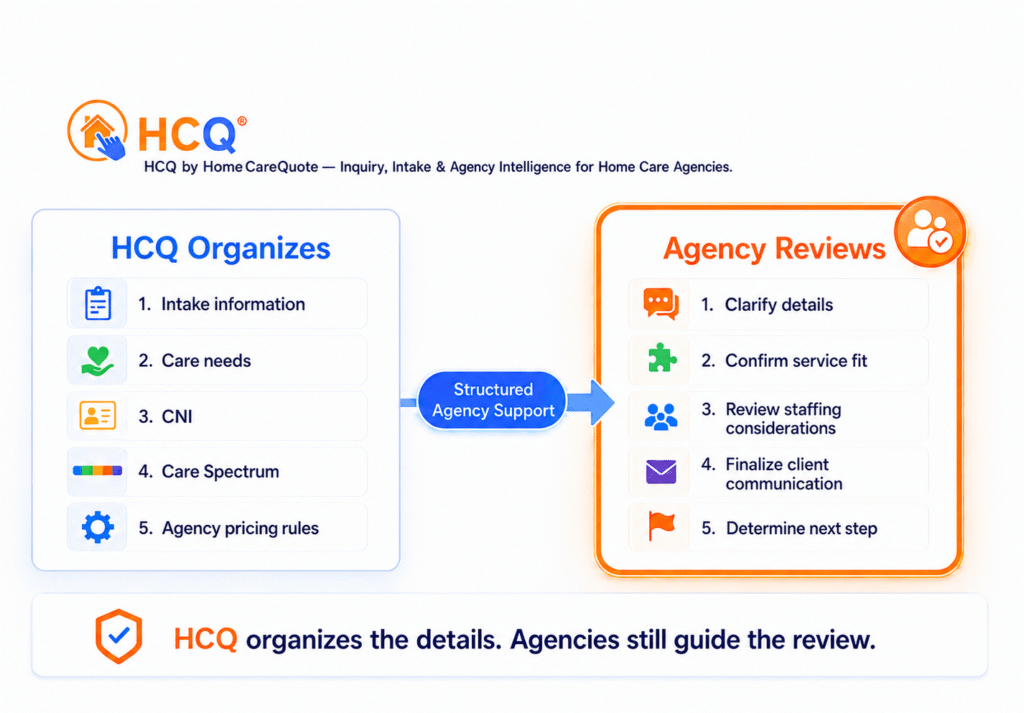
The platform provides structure, consistency, and clarity, while keeping final review and decision-making with the agency.
HCQ is designed to support agency judgment and decision-making, not replace it.

Why Agency Review Still Matters
Every care situation has details that require professional judgment.
Families may describe needs differently. Intake information may be incomplete. Risk factors may need additional clarification. Pricing may depend on agency policies, staffing availability, minimum hours, service type, location, and other operational considerations.
HCQ helps organize the information so the agency can review it more clearly and respond more consistently.
HCQ supports the quote process. HCQ organizes the information. The agency still owns the decision.
What HCQ Helps Agencies Review
HCQ helps agencies review key care information in a more structured way
| HCQ Organizes | Why It Matters |
|---|---|
|
Intake responses
|
Helps reduce inconsistent information collection |
|
Daily support needs
|
Clarifies ADL, IADL, supervision, and household support needs |
|
Safety and health concerns
|
Helps identify complexity, risk, and possible follow-up needs |
|
Care Needs Index
|
Provides a structured way to understand overall care complexity |
|
Care Spectrum level
|
Gives agencies simple language to explain the level of support needed |
|
Agency pricing rules
|
Supports quote consistency using the agency’s own pricing structure |
|
Notes and review items
|
Helps agency staff identify what may need human review before finalizing |
HCQ is Designed to Support Review Before Final Quote Communication
Home care quoting should not be reduced to a simple calculator.
A quote should reflect the care situation, the level of support required, the agency’s operating model, and its pricing structure.
HCQ helps agencies move through that process in a more organized way.
- Intake information is collected more consistently.
- Care needs are organized into meaningful categories.
- The Care Needs Index helps identify overall complexity.
- The Care Spectrum helps communicate the level of support needed.
- Agency pricing rules help support quote consistency.
- The agency reviews the information before final communication.
HCQ brings structure to the quoting process without removing agency judgment.
What HCQ Does Not Replace
HCQ is designed to support agencies, not override them.
HCQ does not replace agency leadership.
Agencies remain responsible for their own pricing, care acceptance, staffing, and client communication decisions.
HCQ does not make medical decisions.
HCQ organizes care needs and support information. It is not a medical diagnostic tool and does not replace clinical judgment, emergency care, or licensed medical advice.
HCQ does not force one pricing model.
HCQ uses the agency’s own pricing structure, base rates, service rules, and operational preferences.
HCQ does not eliminate human review.
The agency remains in control of reviewing the quote, clarifying information, and deciding how to communicate with the family or referral source.
A More Consistent Way to Explain the Care Situation
Families often ask about hours or price before care needs are fully understood.
HCQ helps agencies explain that the quote is based on more than hours alone. It helps connect the conversation to the actual care situation, including daily support needs, safety concerns, complexity, schedule needs, and the agency’s pricing structure.
This gives agencies a clearer way to explain support needs, complexity, Care Spectrum placement, pricing, and what still needs review, rather than relying on hours alone.
How HCQ Helps Improve Care Conversations
HCQ helps agencies organize care complexity and pricing inputs, so final quote communication is clearer, more consistent, and still guided by agency review.
Simple Way to Think About HCQ
HCQ helps agencies answer five important questions:
- What support does this person need?
- How complex is the care situation?
- Where does this client fall on the Care Spectrum?
- What quote is supported by the agency’s own pricing structure?
- What should the agency review before communicating the final quote?
It gives agencies a more organized way to move from intake to quote without having to start from scratch each time.
